Verify AI energy claims with confidence.
Measure a job’s energy, compare it to a fair baseline, and get a clear pass / fail decision — then seal evidence and register the result.
- Measure — attribute kWh to useful AI work under an explicit meter boundary
- Verify — refuse weak baselines, gaming, and unsupported savings
- Record — sealed packages and a live certificate registry
· ·
Get a verification in three steps
No partner data required for the demo. Real sites use the same flow with your job numbers.
Open Verify
Go to Verify and click Load demo — or enter org, hardware, power, duration, and useful work.
Run
AEX attributes energy, builds a same-work baseline, and returns PASS, CONDITIONAL, or REJECT.
Seal & issue
Seal locks a SHA-256 evidence package. Issue writes it to the live registry (optional).
Who uses this
- Ops / platform — job identity, power, utilization, useful work
- Energy / sustainability — boundary, PUE, claims review
- Partners — GPU/PDU CSV path in the Python pilot
How AEX works
Independent verification first. Markets and automation only after methods and buyers are real.
Observe
Telemetry for GPU / facility energy tied to a job and useful work — not orphan rack watts.
Verify
Counterfactual baseline, integrity gates, refuse when data cannot support the claim.
Register
Sealed evidence packages and certificates with double-count guards.
Near-term vs later
| Layer | Role | Status |
|---|---|---|
| Observe | Telemetry & useful work | near-term |
| Verify | Baselines & decisions | primary |
| Registry | Certificates | live slice |
| Flex / Market / Control | Dispatch & contracts | later |
What is proved — and what is not
File-backed pilot results. Pre-registered thresholds are not retuned after outcomes. Production AI energy validation is not claimed.
| Study | Outcome | Status |
|---|---|---|
| Synthetic A–E pilot | Precision 1.0 · FP 0% | PROVED |
| BDG2 inject gate (n=40) | MAE 9.5% → 4.9% certified | PROVED |
| Multi-meter leakage | Refuse 8% · detect 50% | PROVED |
| CalTRACK estimator | MAE ~7.0% vs 7.4% | TIE |
| A–E + DiD / calendar-DiD (primary) | A final 27% · raw 60% · C FP 7% · D 0% | PARTIAL |
M2 gaming early-window (dual_and) | A raw 73% · final still 27% (calendar) · C FP 7% ≤10% | GATED |
| S1-A1 soft calendar (residual) | A final 60–73% with soft-cal · D/C FP risk if stacked | EXPERIMENTAL |
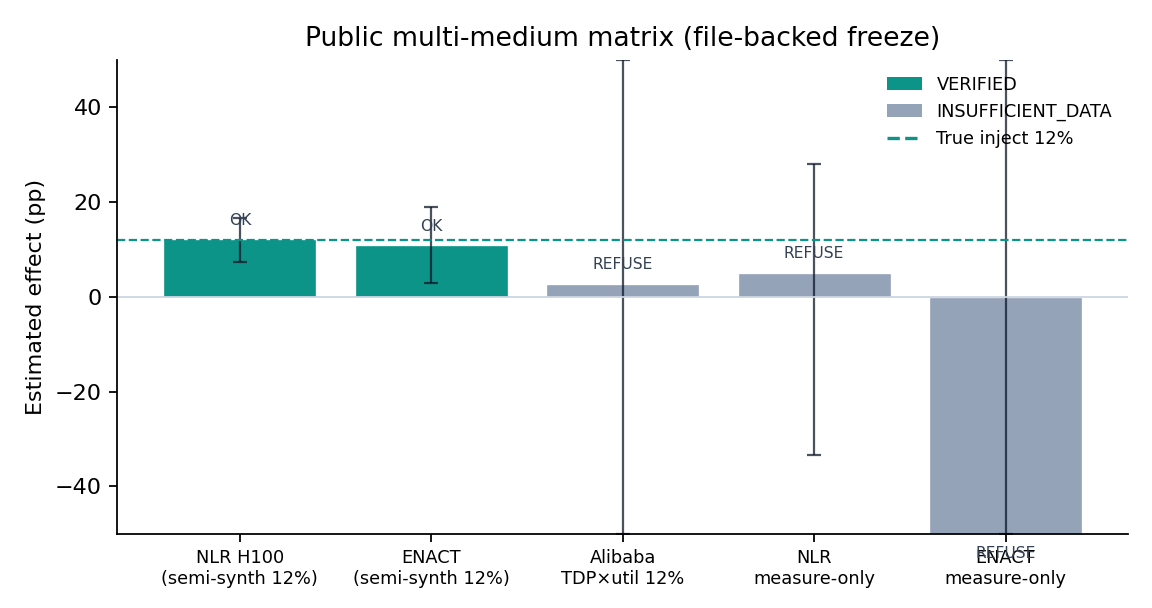
| Public H100 / ENACT semi-synth | VERIFIED inject on real shapes | PARTIAL* |
| Public PM100 / Alibaba TDP×util | HPC pack / estimated refuse | SUITE |
| GPU/PDU wire + partner pack | accept → wire → freeze path | WIRE |
| Production AI energy validation | Needs partner PDU+GPU+job | NOT PROVED |
*Public multi-medium VERIFIED = semi-synthetic inject on real public energy shapes — not hyperscale facility validation. M2 dual_and: refuse baseline gaming only when both chrono-half and first-25% signatures fire (aligns with scenario-C inject; primary C FP stays ≤10%). Do not stack with soft-calendar without separate D/C guards.
Public multi-medium freeze
File-backed packs under benchmarks/frozen/public/ with SHA-256. Partner co-telemetry freezes under benchmarks/frozen/partner/.
- Technical report · multi-medium verification (repo:
docs/technical/PUBLIC_MEDIUM_VERIFICATION_REPORT.md) - One-pager:
docs/technical/AEX_Exec_Summary_One_Pager.pdf - Catalog:
docs/PUBLIC_DATA_CATALOG.md - Partner checklist:
docs/PARTNER_GPU_PDU_CHECKLIST.md - SHA256 freezes:
benchmarks/frozen/public/SHA256SUMS.txt
Verify this AI job
Measure energy → compare baseline → seal evidence → register. Nothing hits the registry until Issue.
- 1Measure
- 2Results
- 3Seal
- 4Issue
Run a verification to see PASS, CONDITIONAL, or REJECT.
Run engines to interpret certifiable savings value (AEX-VALUE-1.0).
Upload or route data
Drop GPU/PDU CSV, summary JSON, or partner claim packs. External systems can also
POST /api/ingest and open this console with ?ingest=<id>.
API route (ingest into the website)
POST https://aex-e0j.pages.dev/api/ingest
Content-Type: application/json

{ "source": "api", "form": { "customer": "…", "accelerator_count": 8, … } }
// or { "raw": "<csv text>", "filename": "gpu.csv" }

GET  /api/ingest/:id     → form + summary
// then open:  /#console?ingest=<id>
Essentials
More fields (identity, quality, PUE, price)
BND Boundary scope select boundary
Device → server → rack → IT → facility → cloud. Only checked components enter e_total.
OUT Measurement output
No measurement yet
Run engines to attribute energy to useful work under the selected boundary.
Device → server → rack → IT → facility boundaries change what is in-scope.
CFG Baseline configuration
Baseline energy is scaled to the same accepted useful work. Doing less work cannot mint efficiency credits.
Δ Actual vs baseline
OUT Baseline result
Awaiting measure pass
Baseline compares attributed energy against an approved reference intensity or historical total at equal useful work.
AES Dimensions class-specific
AES idle
Score is class-specific; do not compare across AES classes without normalization.
VRF Verification decision idle
| ID | Sev | Result | Check |
|---|---|---|---|
| No checks yet. | |||
No decision
Verifier checks boundary fitness, quality floors, rebound flags, and claim strength before seal.
PKG Evidence package unsealed
SHA-256 over stable-canonical JSON. Commitment binds package_id + issued_at. Not a blockchain write.
Unsealed
Seal after a successful verify pass. Hash commits the full evidence package for registry issue.
Not issued
Issue posts the sealed package to the AEX registry (D1). Double-count guards apply on evidence_hash.
Optional tools — not required for day-one verification.
FLX Demand flexibility simulator
No flex event
Simulates curtailable kW given interactive/batch mix, notice window, and SLA risk — not a utility bid.
NFET Operational control cycle
Operational NFET only — regime classify → flex envelope → delay-aware recommendation → control receipt. Does not prove theoretical NFET. Does not issue AEX certificates by itself. Control is real only if an executor ACKs and measured power changes.
No cycle
Optional control sketch for AEX handoff — not certificate issuance.
Registry
Issued proof records. Double-count blocked. Measurement instruments — not carbon offsets.
Workloads tracked: —
Certificates
| ID | Status | Org | Saved kWh | AES | Evidence hash | Issued | Actions |
|---|---|---|---|---|---|---|---|
| Loading registry… | |||||||
No certificates yet.
Certificate detail
No selection
Click View on a row to load certificate metadata and evidence summary from the registry.
Recent audit events
No events loaded
Issue and retire actions append to the audit log.
Look up by evidence hash
Idle
Lookup by evidence_hash. Local seal re-check runs if the hash matches the package sealed in this session.
API reference
GET  /api/health · /api/stats · /api/certificates
POST /api/issue · /api/verify · /api/retire
Methodology (disclosed)
Versions used by live engines. Speculative market claims are excluded. What you measure is what you may claim — nothing more.
Energy attribution
Total workload energy = sum of boundary-included components:
- Accelerators, CPU, memory, storage, network
- Shared IT allocation
- Cooling & power-loss via PUE split (75/25) when facility overhead is in-boundary
Useful work is quality × latency adjusted. Intensity is class-specific (Wh/1k requests, J/image, kWh/milestone, …). Productive util is clamped ≤ GPU util. Component sum must match e_total. Metering quality is labeled (power_x_time, tdp_x_util_estimate, …).
Baselines
Methods: historical, control, benchmark, regression. Savings require same useful-work volume — doing less work does not mint efficiency. Confidence scales with boundary strength and method quality. Flags: NO_USEFUL_WORK, NO_SAVINGS, REBOUND_RISK, BOUNDARY_WEAK, REGRESSION.
AI Efficiency Score
Not universal. Dimensions: intensity 35%, infrastructure 15%, utilization 20%, model vs baseline 20%, service quality 10%. Do not rank models or facilities across AES classes without an explicit normalization method.
Verification & evidence
Critical gates reject packages without useful work or positive savings. Major conditions cover device/cloud boundary limits, power vs TDP, duration, and intensity-unit match. Evidence is SHA-256 sealed (not a chain write). Registry issue refuses VERIFY REJECT, zero savings, and malformed hashes. Flex models deliverable kW from mix × notice × duration; utility $ are scenario inputs only.
Pilot economics
Scenario calculator only — edit every input. Results are not revenue forecasts. Certificate price defaults to $0 (no assumed market).
Ideal first customer
Mid-size inference or training operator (50–500 GPUs) with partial rack metering, Kubernetes/Slurm job metadata, and a cost owner who cares about $/token and peak demand — not only ESG slides.
Ideal first utility partner
IOU or municipal utility with existing commercial DR / flexible-load programs and large data-center interconnection queue in the same territory as the pilot cluster.
Open questions and honest risks
From Concept Overview v1 — stated so external framing cannot overclaim.
What AEX actually is
The Energy Intelligence Layer for the AI Economy: measurement and verification first, evolving toward optimization and market infrastructure. The “exchange” is aspirational — not the day-one product.
Independent Verify
Statistically rigorous verification of claimed savings and flexibility — complementary to Emerald / Nvidia / Google Flex, not a head-on Control product. Cost + peak evidence for operators; verification services for utilities and regulators.
Baseline engine + evidence graph
Defensible counterfactuals, useful-work definitions, double-count controls. Hardware telemetry is commoditized; verification libraries and methods are not.
Go-to-market & competition
No first customer fully defined yet. Layers 3 and 6 face funded competitors with multi-year head starts. Formal CSP/DR markets imply regulatory overhead not yet scoped. Trust requires an anchor partner (utility, lab, or hyperscaler).
Unvalidated on energy
Applied layer C+/B–, traffic-only validation. Synthetic pilot is necessary but not sufficient; real telemetry needs a second pass. No claim linking NFET to LOLM development without documentary support.
Soft credits / greenwash
If AEX issues unverifiable baselines or soft claims without useful-work gates, it becomes another low-integrity market and serious buyers leave.
Who is already here
Emerald Conductor + Nvidia flexible AI factories; Google internal DR; EPRI DCFlex standards; Watershed/Persefoni-class carbon MRV. Gap: independent AI-energy verification with statistical rigor.
Should AEX be built?
Yes — as measurement & verification infrastructure. No — as a day-one Flex/Control stack or credit exchange. This site implements Observe/Verify/Registry slices with honest non-goals for the rest.
Recommended next steps (from overview)
Assumptions that require validation
- Operators will share fine-grained job + power data with a third party.
- Useful-work definitions can be standardized per class without gaming.
- Utilities will accept AI load as a DR resource with AEX-grade metering.
- Any secondary instrument price is non-zero — treated as $0 until proven.
- NFET methods transfer from traffic networks to energy multiplex systems (unproven).